

Key Takeaways
-
Amazon-style chaotic storage (dynamic storage) is a system-led layout strategy, not “put it anywhere and hope.”
-
Done well, it reduces wasted warehouse space and lowers mispicks by removing guesswork.
-
The operational requirement is simple but strict: scan every move so inventory stays trustworthy.
-
Most warehouses succeed with a hybrid: a controlled pick face plus dynamic bulk storage.
Amazon’s warehouse layout seems like something out of a sci-fi movie. Robots driving towers of perfectly organized products to pick stations? Next-gen technology masterfully orchestrating a barcode-based ballet of online order fulfillment? It’s gorgeous! But isn’t an Amazon-type warehouse completely unattainable for small to mid-sized ecommerce brands?
No. You don’t need robots and an Amazon-sized operations budget to adopt the heart of this warehouse strategy: chaotic storage. Any brand can leverage it using human pickers, a mobile warehouse management system (WMS), and a layout strategy that separates what humans need to move fast from what the building needs to store products efficiently.
Here’s a closer look at chaotic storage and how to use Amazon’s fulfillment playbook to upgrade your warehouse operations.
What Amazon's "chaotic storage" actually means
Instead of grouping products like a retail store (all gray t-shirts together, all yoga mats together), Amazon popularized a warehouse layout strategy often called chaotic storage.
Items are placed wherever there’s available space, and a barcode-based system tracks the exact location.
Chaotic storage (also called dynamic storage, random storage, or random stow) means your WMS can direct putaway to any valid open location.
Your team scans the item and its location so the system always knows where it is.
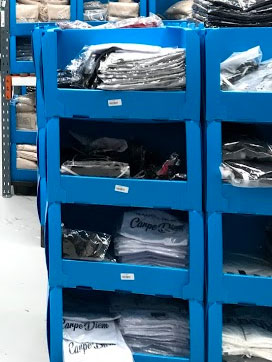
This may seem like a haphazard way to do it, especially for warehouses that still rely on visual scanning or “the person who knows where things are.” But that system memory is the whole point. Your warehouse stops depending on people remembering where products “should” live because the WMS tracks every item. It guides pickers to the correct location every time.
This barcode-based approach is useful in both manual and robot-supported environments. The common thread is not robotics. It’s scan discipline and software-led location control.
Why “store-style” slotting breaks as you scale
A store-style warehouse layout (everything grouped by product type) feels organized, but it creates two problems that show up fast in direct-to-consumer (D2C) fulfillment:
You increase mispicks on lookalike items
If all sizes and variants of a similar-looking product sit together, your risk of mis-picks goes up. That risk spikes during peaks and promotions, when you are onboarding temps and pushing higher pick rates.
Amazon’s process emphasizes scanning as a control. In manual picking, pickers scan the shelf/location barcode, then the item barcode to confirm the pick. The warehouse management system will deliver an error message if the picker tries to scan the wrong item.
That same concept applies in a mid-sized D2C warehouse: the system should validate every pick so the wrong item never ships to a customer.
You waste usable space
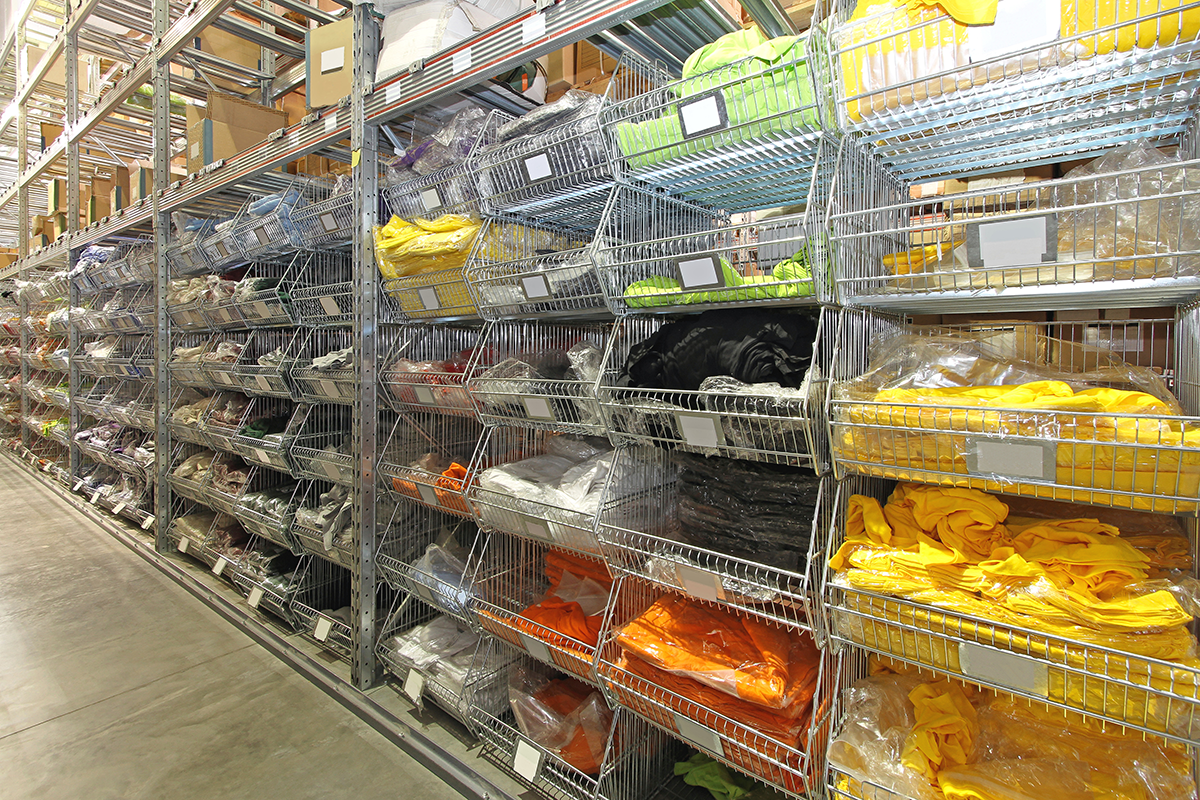
When every SKU is assigned to a fixed home, you end up reserving space you don’t always need. One bin might be overstuffed while another sits empty, taking up valuable shelf space. In the example below, this warehouse leaves empty bins on the shelf, turning them sideways to indicate there’s nothing inside.
In contrast, random stow optimizes available space by storing items where they physically fit, instead of where they “belong.” Amazon has benefitted from this strategy for over 20 years. In a 2013 60 Minutes segment, Amazon said it could store twice as many goods in its centers as it did five years earlier after improving how it stowed inventory. And Amazon fulfillment centers still use this type of storage today.
Better space utilization happens when your layout strategy allows the warehouse management system to fill gaps immediately. But how can anyone find things when SKUs no longer live in a fixed location? What does it take to implement chaotic storage?
The real requirements to run dynamic storage successfully
Chaotic storage is only “chaotic” visually. Operationally, it is strict and follows a logical set of principles any ecommerce brand can implement.
To implement this strategy, you need:
-
A consistent location naming convention (zone > aisle > bay > level > bin)
-
Physical labels and barcodes on every pick and storage location
-
A WMS with mobile barcode scanning capabilities
-
A standard operating procedure to scan the barcodes for every receiving, move, replenishment, pick, and pack step
-
Clear rules for what can and cannot share a bin (for example, keep regulated or fragile items separate)
-
A cycle count process to protect inventory accuracy over time
If any one of these is missing, dynamic storage can turn into actual chaos. However, guided implementation is available to help brands successfully roll out barcode scanning and dynamic storage in the warehouse.
An Amazon-inspired warehouse strategy you can run without robots
Most small to mid-sized D2C brands do best with a hybrid “Amazon-inspired” layout strategy. Rather than relying on robots, which may be cost-prohibitive for non-enterprise brands, this approach uses human pickers.
Like the robots, workers follow a guided route to maximize efficiency, and barcode-based dynamic storage ensures accuracy.
Step 1: Build a fast pick face near packing
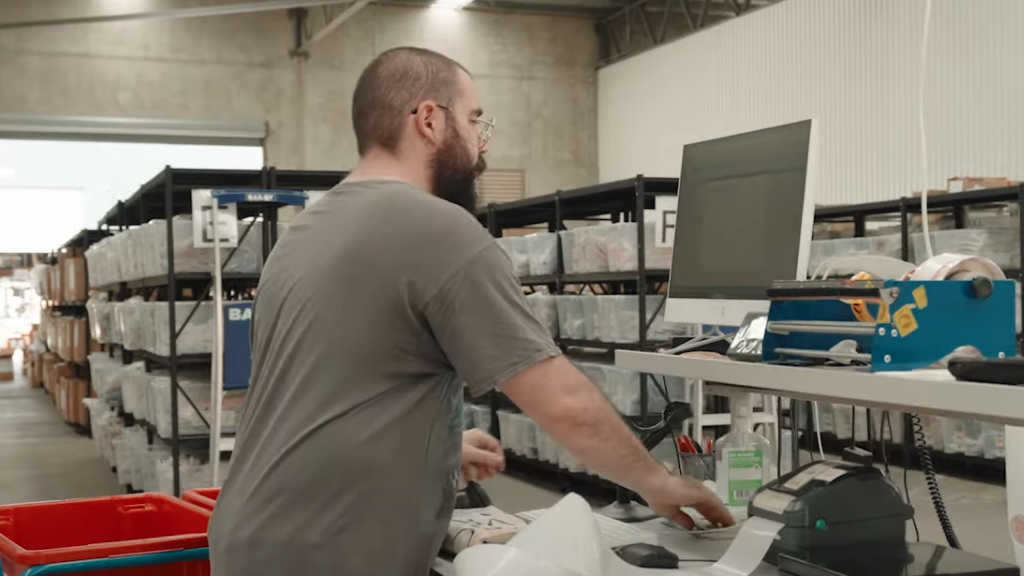
Create a dedicated pick face for your highest-velocity SKUs. This is your “easy access” area and should be laid out to minimize walking and simplify replenishment.
Tips:
-
Keep top sellers closest to pack-out
-
Slot by velocity and handling characteristics (small items, fragile, apparel, etc.)
-
Make replenishment easy (clear min/max or replenishment triggers)
Step 2: Use dynamic storage for bulk storage areas and pickfaces
Amazon fulfillment centers store products in coded bins, stowed at random in portable storage towers called “pods,” which resemble portable pickfaces. This type of code-based dynamic storage gives workers the flexibility to stow products in any pod without losing track of them. You can do the same with a WMS and barcoding.
Instead of forcing every SKU into a fixed home location, let the system direct putaway into any valid open location based on rules you set (capacity, zone, product type constraints, and travel efficiency). This lets you maximize available warehouse space for pickfaces and bulk storage.
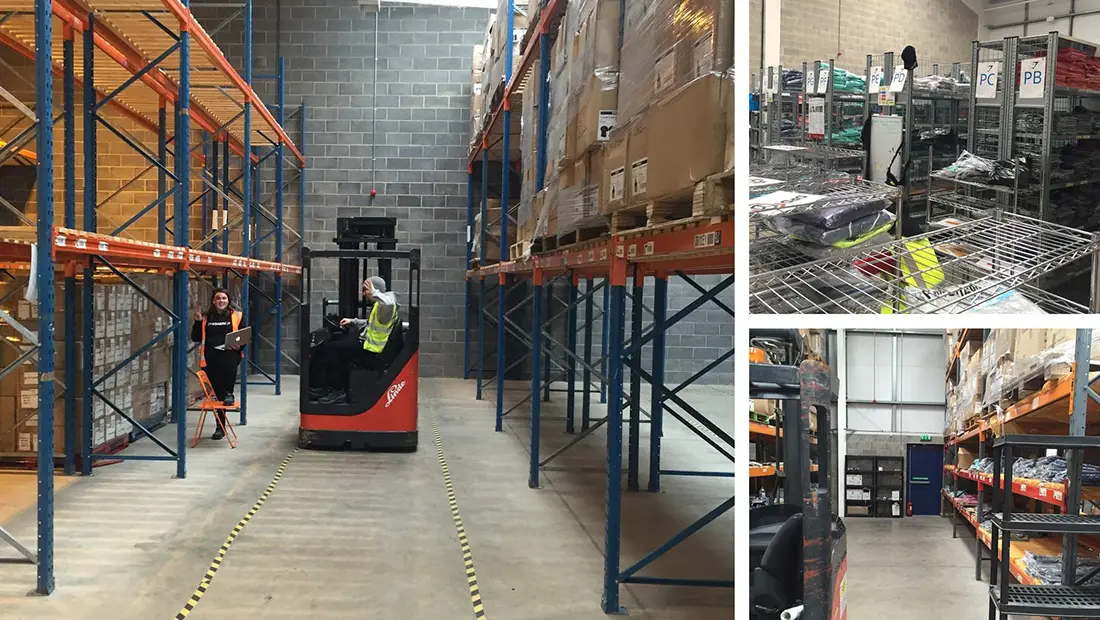
With a WMS, you can store the same SKU in multiple locations. Then, when it’s time to replenish pick faces, the warehouse management system will guide you to the precise bulk storage location for the items you need.
Getting ready for a flash sale or promotional event? Set up a temporary bulk storage area and pick face with related SKUs near the packing benches. Then, move them back after the event is over.
Step 3: Enforce scan-based standard operating procedures
In an Amazon fulfillment center, robots and human workers follow barcode-based workflows from receiving and putaway to picking and packing. Your warehouse can follow similar scan-based standard operating procedures (SOPs), even if you don’t use robots.

Inventory putaway and product movement
When putting away and relocating items, use SOPs to track the dynamic locations:
- Bulk storage putaway (scan barcode on bulk box, scan bin location)
- Remove units from bulk storage (scan product, enter quantity, scan bulk storage location)
- Replenish pickface (scan product, enter quantity, scan pickface bin location)
Pick and pack verification
To eliminate mispicks, you need two barcode-based SOPs:
-
Pick validation (scan bin location, then scan item barcode)
-
Pack validation (scan items going into the box before the label is printed)
Step 4: Use trolleys with bins for multi-order pick runs
Amazon’s robots function as pickers. Instead of a worker walking through the warehouse to pick an order, a robot retrieves the pod containing the item and drives it to the pick station. Then, the human worker picks the item from the pod, inspects it, places it in a tote, and the robot drives away.
You can mimic this efficient fulfillment workflow without robots by using a trolley with bins for multi-order picking. A human worker performs the robot’s job in this example:
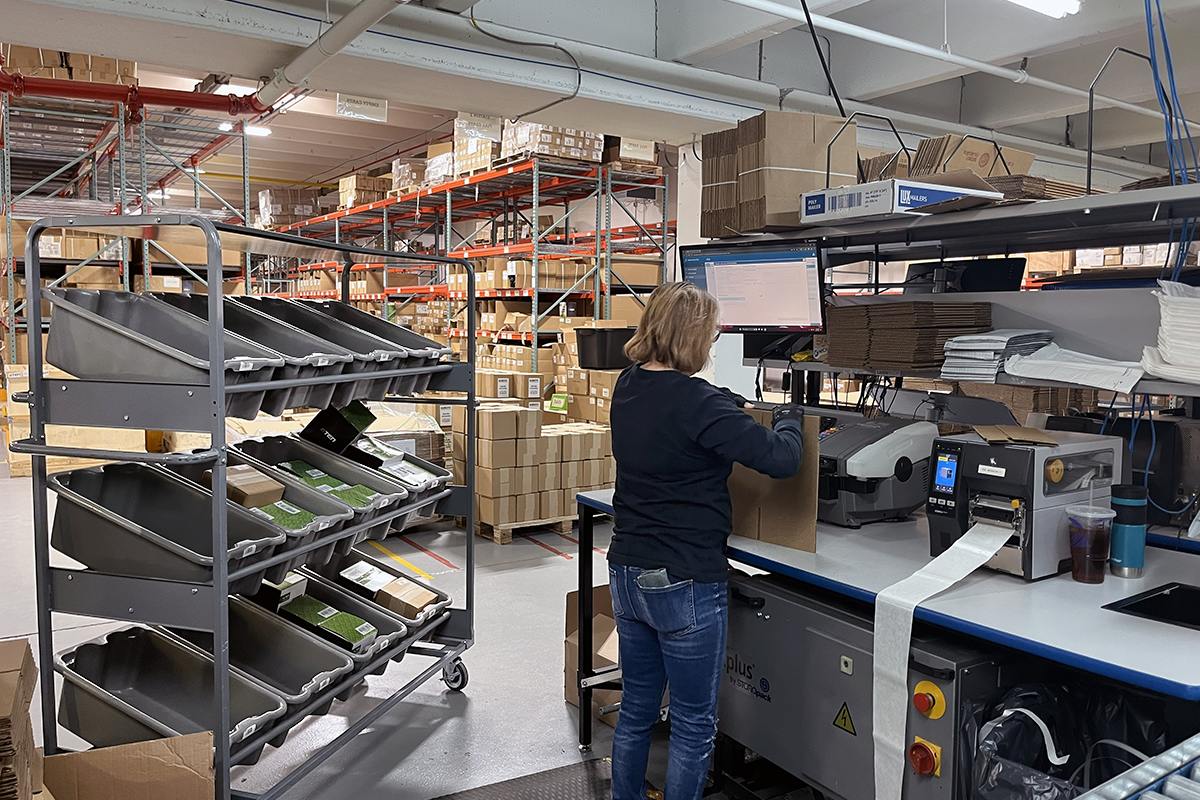
In the example above, a human picker already took the trolley on a multi-order pick run, guided along the most efficient route by a mobile WMS. Each bin on the trolley now contains a single or multi-item order. The picker parked the trolley at the pack station and took an empty trolley on another pick run.
In the meantime, the packer is retrieving the order from each bin. She scans it to verify the correct items go into the box, packs it, weighs the parcel, prints a shipping label, and finally sends the parcel down the rolling conveyor to the carrier pickup zone.
What to look for in a WMS to support dynamic storage
If your goal is an Amazon-style warehouse without robotics, you will need a mobile warehouse management system built for dynamic storage. Your WMS should help you:
- Store and retrieve barcoding information related to products and bin locations
- Receive and put away goods with barcode-driven workflows
- Automatically guide pickers along the most efficient routes
- Prevent mis-picks by validating picks and packs with scanning
- Track product movement with a clean audit trail
- See employee productivity and bottlenecks through reporting dashboards
Descartes Peoplevox is an example of this type of WMS. It’s a mobile-first ecommerce warehouse management system designed for fast-growing D2C brands that need accuracy, visibility, and scalable fulfillment workflows without relying on robotics.
Business results from brands using dynamic storage
If you want evidence that this strategy can work outside of Amazon’s environment, here are a few relevant examples from ecommerce operators:
-
DISSH: After moving to dynamic storage and implementing location types plus replenishment flags, DISSH reported maximizing warehouse space by 44%. With barcode scanning workflows in place, the company reported a dramatic reduction in error rates, leading to fewer returns, increased customer satisfaction, and enhanced brand reputation.
-
LOVALL: By creating a bulk storage and pick face combination with dynamic locations, the athleticwear brand reported being able to store 3x as much stock in the same warehouse space.
- Natural Baby Shower: With barcode scanning workflows, this business achieved “100% Stock Accuracy – The system tracks every product from arrival to dispatch, eliminating errors.”
-
State & Liberty: After implementing barcode scanning, the clothing company saw 75% faster picking using 67% less labor. “Four people with barcode scanners do all of our picking in the first two hours of the day… it’s a massive improvement.”
The outcomes are not unique to these businesses. They are proven, repeatable results achieved by combining layout strategy, barcoding, and a WMS that enforces the workflows your team needs to follow.
A smarter way to think about warehouse layout
What can we learn from Amazon’s warehouse layout? Optimize for throughput, space utilization, and accuracy by adopting scan-based workflows and chaotic storage. By leveraging technology to speed up fulfillment operations and virtually eliminate human errors, you position your brand to delight customers and beat the competition.
Ready to see dynamic storage in action?
If you want to see how dynamic storage could work in your operation, a good first step is to request a demo of the Peoplevox WMS. It supports dynamic storage and scan-led workflows, maximizes the efficiency of human workers, and doesn’t require robots.
Chaotic storage FAQs
Can dynamic storage work without robots?
Yes. The core requirement is not robots. It’s scanning and software-led location control. In a manual warehouse, you can still run dynamic storage if every putaway, move, pick, and replenishment step is tracked by scan.
Will chaotic storage reduce mispicks by itself?
Not by itself. The accuracy improvement comes from scan validation at pick and pack, plus rules about what can be stored together.
When is it bad to use chaotic storage?
Chaotic storage (dynamic storage) is not an “everything goes anywhere” rule. It can cause problems when the product or process needs tighter controls than a flexible layout can provide.
You should use fixed locations or rule-restricted zones when you have:
-
Hazmat, regulated, or temperature-sensitive inventory that needs controlled storage conditions
-
High-value items that require restricted access, added security, or tighter audit controls
-
Oversized or awkward-to-handle products that need dedicated racking or handling space
-
SKUs that require special packing materials, kitting, or quality checks that are easier to run from a defined area
In most warehouses, the best approach is a hybrid layout strategy: keep dynamic storage for bulk and long-tail inventory, and use constraints or dedicated zones for anything that needs special handling.
What’s the biggest mistake when switching to dynamic storage?
Trying to run dynamic storage with weak location labeling, inconsistent scanning, or no replenishment process. If inventory accuracy is not trustworthy, the system cannot direct labor effectively.